ServicesRoof Repair
Roof Repair in Stroud
A wet spot on the ceiling or shingles scattered on the lawn doesn't automatically mean a new roof. We trace the leak back to its true starting point, repair it the right way, and tell you honestly how many good years your roof still has.
Is a Repair Enough for Your Roof
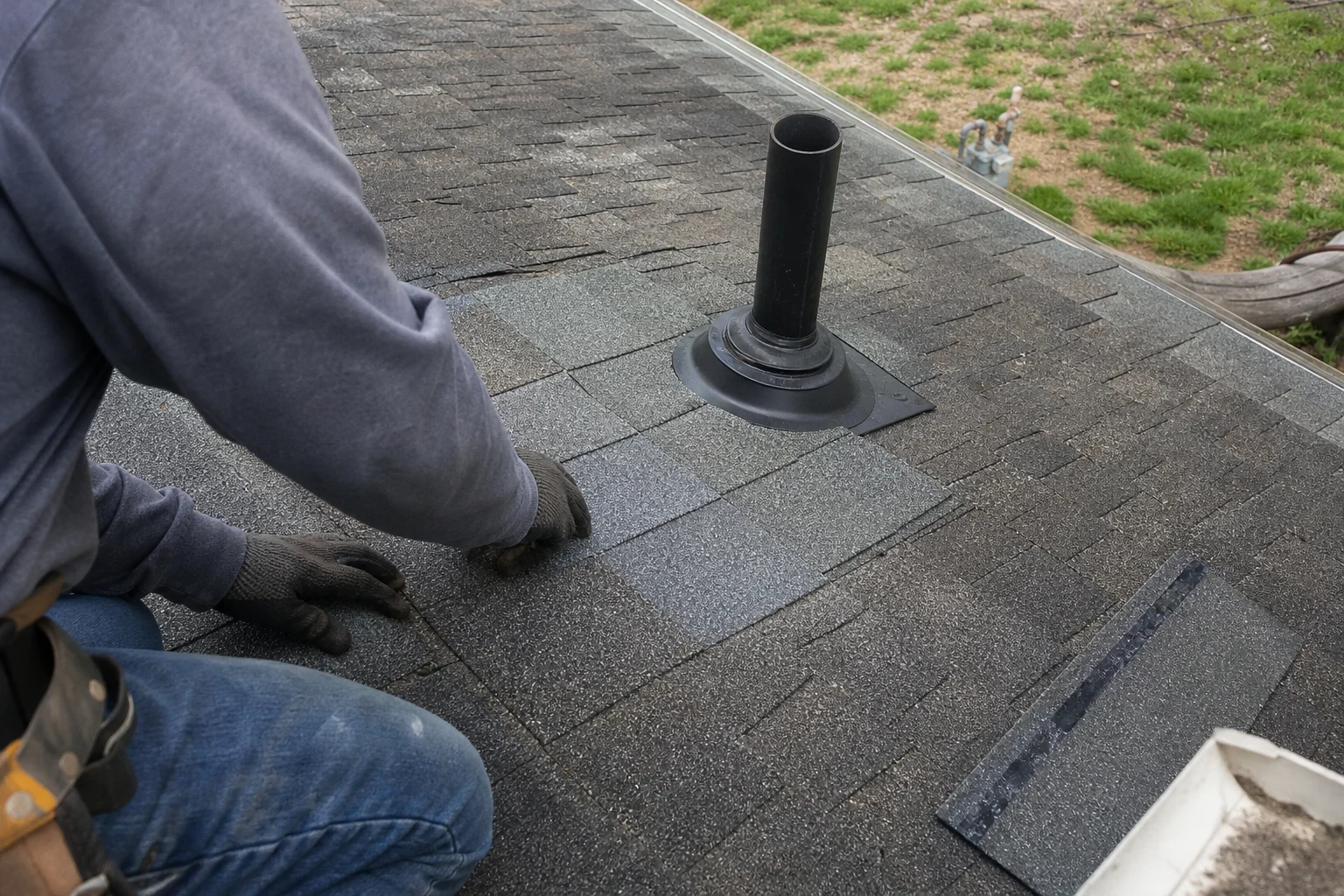
Roofs rarely wear out all at once. Trouble usually starts at one weak point: a split pipe boot, a nail that worked loose, a strip of flashing that let go at the chimney. When the rest of the roof is in good shape, fixing those few spots makes sense and costs far less than a tear-off.
A leak also does damage you can't see from the living room. Water gets into the attic insulation, and soggy insulation barely slows heat in winter or keeps it out in summer. Catching it early can keep your heating and cooling bills from slowly climbing.
Between us, we bring over 20 years of combined roofing experience. That time on roofs helps us tell a patch job from a roof that's simply used up. If a new roof is the smarter spend, we'll tell you and walk you through why.
What We Handle on a Repair
Tracing the leak
Water travels down rafters and decking before it ever drips onto drywall. We follow it uphill from the stain to the opening, which is often a few feet away.
Replacing shingles
Torn, cracked or loose shingles come off and new ones go on, matched as closely as possible. We nail and seal each one to the maker's instructions.
Flashing and vent boots
Leaks love the joints where the roof meets a chimney, a wall, a skylight or a pipe. We reseal or replace the metal flashing there and put in new rubber boots where the old ones have split.
Rotted decking
When the plywood under the shingles has gone soft, we cut that piece out and fit new decking before closing up. Shingling over rot only hides it.
Attic vents
Broken ridge vents and clogged soffit intakes keep hot air stuck in the attic. Getting air moving again helps the shingles last and eases the work on your AC.
How to Tell Your Roof Needs Fixing
Water marks inside
Yellow-brown spots on drywall or paint that bubbles and peels mean water is getting in. Expect them to spread after each hard rain.
Shingles on the ground
High wind can lift shingles and snap them off. The bare patch leaves underlayment exposed, and it isn't built to face the weather for long.
Grit piling up in gutters
Some loose granules are normal. Heavy piles after a storm can mean hail bruising or shingles wearing thin.
Wet or matted insulation
Insulation that's damp, packed down or stained tells you a leak is already chipping away at comfort and adding to your energy bill.
Light through the roof boards
If you can see sunshine from the attic, there are openings that let in rain and outside air.
A room that won't stay cool
A bedroom under a hot, badly vented attic can start running warm. A broken vent or soaked insulation may be the cause, not the AC.
What Happens on a Repair Job
- 1
Tell us about the problem
On the phone we ask where the stain shows up, when it appears and what the weather was like. That gives us a head start on what to check.
- 2
We look over the roof and attic
We climb up to check the shingles and flashing, then look in the attic from below if there's access. Everything we find gets photographed so you can see it too.
- 3
You get the estimate in writing
Each repair is listed on its own line. If your roof is close to worn out, we say so, and the choice stays yours.
- 4
The repair and the cleanup
Tarps go over flower beds and we keep scraps away from your siding. When we're done, old shingles and nails get hauled off and a magnet sweep goes over the lawn and drive.
What Sets the Cost of Your Repair
We can't put a number on a repair until someone has looked at it up close. A ceiling stain from a loose nail and one from rotted decking can look identical from the hallway. Your estimate spells out each item and the reason for it, and if something new turns up mid-job, we talk with you before doing more.
- How much roof is damaged
- Swapping one cracked vent boot goes quickly. A strip of shingles peeled back across a whole slope needs more material and more hours.
- Condition of the decking
- Wood that has gone soft must be cut out and replaced before shingles go back on. That only becomes clear once the old shingles come up.
- Pitch and how we get up there
- A steep slope, a two-story wall or a cramped valley by the chimney means extra safety setup and slower, more careful work.
- Finding matching shingles
- Some older styles are no longer made. We track down the nearest match and show it to you before anything goes on the roof.
Questions About Roof Repair
Something not covered here? (405) 855-9152
How do I know if a repair is enough or I need a new roof?
Age and overall condition decide it. When the trouble is limited to a spot or two and the shingles elsewhere lie flat with their granules intact, fixing it is usually the better value. When leaks keep turning up in different places, a roof replacement can work out cheaper in the long run. We'll show you photos and tell you plainly what we'd do on our own house.
Do your repairs come with a warranty?
They do. Every repair we make carries a lifetime workmanship warranty. It covers the way we did the work. Defects in the shingles themselves are handled under the manufacturer's coverage.
Can a roof repair cut my heating and cooling costs?
Sometimes. If water has soaked the attic insulation or a vent is broken, fixing that helps, because damp insulation holds back very little heat and a stuffy attic makes your AC run longer. If the insulation is dry and air moves fine, the repair mostly protects your home rather than your utility bill.
What if hail or wind caused the damage?
Storm damage tends to reach more of the roof, and it often comes with an insurance claim. Our storm damage repair page covers how that works. We can photograph and write up what we find so you have it ready for your adjuster.
Do you take repair jobs outside Stroud?
We do. We also handle repairs in Chandler, Cushing, Bristow, Drumright and Perkins. Just let us know where your home is when you phone.
Don't Let One More Rain Soak In
A slow drip spreads into insulation and wood a little more with every storm. Give us a ring, describe the stain or the damage, and we'll pick a day to come out and check it.